Christie is the Founder & CEO of UChic. She’s also a Millennial, the market her company targets.
UChic is a mission-driven lifestyle brand whose products sales empower our teen girl consumers through scholarships. Our research found that 95% of young women in the U.S. lack the funding to pursue their dreams outside of the classroom. Knowing that these extracurricular experiences can change lives, we launched our company and foundation in 2013, and are getting set to launch our first product — the “Gracie,” a fashionable computer case for the classroom and beyond. The case, available right now through Indiegogo, will help fund the dreams of over 10 deserving young women with $1000 scholarships, kicking off the company’s on-going commitment to funding the dreams of young women through our product sales.
I was inspired to start UChic based on the success we’ve had in creating the best-selling guidebook to college written “for and by” young women — U Chic: The College Girl’s Guide to Everything (Sourcebooks 2013). Over 100,000 book copies have been sold since, and a fourth edition is in the works. Call me a Millennial, but I wanted to do more to empower our consumers.
What are the benefits of the Millennial consumer market when considering a new product launch? How does their involvement with brands influence their peers’ power to purchase as well as to the co-creation of products?
As a Millennial, I know first-hand how much our generation desires to have a “voice” in the world (that’s partly why I created UChic — to give my generation and younger a platform) and thanks to the technological advances we’ve seen happen over the past decade, we have more power than generations that came before us. From presidential campaigns to regime changes in the Middle East to new product design, Millennials are changing the course of “business as usual.”
From the research, we know that compared to older generations, Millennials have 200 more friends on Facebook and are more likely to use social media to express their feelings and opinions, which makes them more influential in their ability to spread the word farther and faster. As consumers, Millennials’ purchasing decisions are also more likely to be influenced by what their peers have to say, so it is critical for companies to figure out how to be a part of these conversations. One way to do it is to ask Millennials to help “co-create” the products they want.
What are the disadvantages of managing the expectations of Millennials when it comes to product development?
The desire for instant gratification in the digital age can make the millennial consumers’ expectation quite high when it comes to product development. If something goes wrong — and yes, even Facebook can get it wrong at times — Millennials are more likely to share their angst on social media. And because of their larger and stronger social networks, such despair can travel far and wide, becoming viral within a few hours of the first unhappy Tweet. Companies can manage these higher expectations by being transparent from the start on the product development process.
What are some of the latest tools and techniques for conducting cost-effective market research with Millennials?
Online surveys and community engagement strategies (i.e., posting questions on FB or Twitter) are some the best and most cost-effective tools around when it comes to conducting market research with Millennial consumers. From my research, Millennials like to weigh-in on the market research process; it gets back to that desire to have a voice or say in the world.
Whether it’s simply positioned as an “exclusive opportunity” to take part in a new product launch or tied to an incentive like a gift card, Millennials are open to being engaged in this manner. And better yet, figure out a way to follow up with them once the product has launched for additional feedback. Couched within a question of “Did we get it right?” should open the door for additional engagement and feedback that can be good for the bottom line.
Ever wonder whyou like to visit some websites over another? How some have features that are more intuitive or enjoyable to read? This isn’t the result of a guessing game, it’s the hard work of people like Billy Carlson, the Director of User Experience at Threadless.com.
What is Threadless?
Threadless is an online retailer. We sell mostly t-shirts, but other products like iPhone cases, wall art. But our unique business model is that we are crowd sourced design. So, anyone in the world can submit their design to our website, and then our community of over three million users will go on the site and vote for their favorite design with a score between 1-5. Each week, there’s a new set of submissions up for seven days, and then at the end of each cycle, the top vote-getting design gets printed and sold on our website.
You’re being watched. Billy analyzes user experience on Threadless.com, to make your experience more seamless.
We are very community-focused, and we’re focused on not only our customers, but our artist base. And we’re very unique in the way that we try to do as much as we can to promote our artists and find the best way for them to monetize their artwork. For example, we currently have a whole line of greeting cards at Target. So we’re trying to branch away from not only Threadless.com, but trying to find great outlets for independent artists to monetize their artwork.
As we all know, a website is really the digital storefront for an organization in the e-commerce industry. Therefore, ease of use, the customer experience, and usability have to be really on point. What are your tips for improving these features to increase the pleasure experienced by your customers, so that they keep coming back and will be loyal and satisfied with their experience?
We’re very lucky, because we have a very vocal fan base of customers and artists. We hear a lot of feedback from them through our social media channels and they also email us. We have a huge forum on our website that gets so much use; there are so many users on there discussing what we do.
But on top of that, we also like to do usability tests; A/B tests for ideas. For example, we redesigned our homepage because we found that we had a promotional slider at the front and center, like many sites do, but users were not waiting to see the other slides, so it was sort of a waste. It was also very engineering-heavy. So we had the idea of the slider, we were taking a lot of time to support it with graphics and more and then when we redesigned it, we listened to our analytics from Google and also what our customers were telling us and we totally redesigned the homepage to be more effective. There are a lot of different areas that explain different parts of the website so it’s not just commerce-focused, it tells the customer about the artist and it gives the artist a chance to shine and hopefully to give them a little more promotion.
We try to listen and then learn. I think it’s pretty simple, but I think it’s also important to never stop iterating on a design. You should work on a design, analyze it, keep tweaking it and don’t stop. Don’t feel like it’s ever finished, I guess.
That leads me into my follow-up question, which is: how do you know when it’s time to update your user interface? And with these updates or these changes, and you mentioned that it was kind of engineering-heavy, how do you not throw off the functionality or what people are used to?
Yeah, that’s interesting. I think we’re always involved in a part of our site. And so, we worked heavily on the homepage for a while at the beginning of this year, and we’ve moved to other parts. And what we like to do is kind of cycle through.
So for instance, we spend a lot of time focusing on a section of the site and will continually do so. We will cycle through the entire site once annually to do major overhauls, but not every eighteen months. It’s typically, again, not only is it us determining if we would like to redesign something, maybe we don’t like the interface anymore. But we’ll listen to our customers and watch what their behavior is, and see if a design is the solution to fixing a usability. Sometimes it’s text-based, Using the proper words can really help change how a page is viewed by a user. A good example of that is that we redesigned our main navigation and titles of our sections our website in the fall of 2012. It was really marketing-heavy and called “make, pick, play, and shop.” But we found that a lot of our users didn’t really understand the difference between picking and shopping. The lesson learned was that sometimes, using clear, actionable copy is the best way to go. Sometimes you want to be a little fun, and sometimes you just need to get right to the point.
How important is the design of the interface to sales?
I think it’s very important to design a layout that properly guides the user into what; the purpose of a page is to learn about a product, and then hopefully select your sizes and options and buy it. You don’t want to bury anything. You want to make sure that you first think of the user’s experience, and then you try to layer on all the design layouts to match that.
I think it’s really important nowadays to be conscious of the different types of devices that people use to access your site and the different screen sizes. So you know, we’ve been moving slowly towards a responsive or adaptive website that, any type of device could view our website much easier than they could even like a year ago. But I think design, not only visual design, but the user experience design, is extremely important to making a great interface. It really helps guide your customers and your users to like, you know, what to do.
And we’re still always tweaking. Our product pages aren’t perfect yet. There’s still more we’d like to do. We’re getting there soon. But again, I think it’s always, think of your customers first. Think of making the actions that need to be put on the page very simple and clear. And then continue to iterate on that.
So I just want to switch gears a little bit, because this is what you’ll also be addressing at the conference, is the differences between marketing research and usability testing. So, could tell us maybe the benefits of usability testing if it’s executed correctly? And maybe explain what the correct way of implementing it?
Sure, we definitely like to test our new features to make sure that any assumptions are correct. So we’ll design an interface or a user experience in a certain way, and we’ll probably A/B test that with the current version to make sure that there is improvement in our users’ thought process while they’re using our product.
We are planning on redesigning our product page and we’ve made some assumptions and changed a lot of things. Our plan is to test each of these pages and make sure that we didn’t change something fundamentally that would confuse our users to buy it. I think it’s really important and it’s really easy nowadays to do usability testing. So I really don’t think there’s an excuse to not.
Could you give us an example of how leveraging insights from consumer behavior on Threadless and/or your mobile app could inform new features or streamline your existing features?
Yeah, that’s a great question! It happens a lot here at Threadless, because we really listen to what people tell us. So, one of the things that I mentioned earlier is that we used to have a promotional marketing slider on the homepage, but we noticed that it wasn’t getting a lot of clicks or attention.
We listened to our analytics and a lot of people told us that they don’t ever even notice it. So we actually redesigned the homepage based on this feedback, took those slides out and made more of a promotional area that was longer and with more content. That definitely increased visibility into what we were doing. We were able to tell a better story of that week’s artist, because we didn’t have one area moving and then everything else below it that not even being noticed.
We really want to focus on our artists. So making this change allowed us to do that. It allows us to spotlight our favorite design of the week, the artist who designed it, and where they’re from.
Again, I want to talk about the navigation. We found from research that the navigation was confusing, so we reverted back to the previous language. At Threadless I am also the Mobile Product Owner. We do a lot of testing and listen to a lot of consumer insights for mobile apps. So, it’s the same thing. We’re currently developing a new navigation system in our mobile app because we’ve heard from a lot of people and in analytics that they just don’t use this feature we built. So we’re going to come up with a new version that we feel is better.
And I think that’s just kind of how it goes. You have to listen to everyone’s opinions and then sort of step back from what you made and really think about it. A lot of the time we get great insights and we’re able to act on them quickly, so it’s nice.
Is your organization struggling with strategic measurement? You may be tracking the wrong things.
Chris Abel is a simple man. So, he isn’t quite sure why call centers continue to struggle with measurement. Call Centers excel at measuring everything an agent does, he says, but not necessarily how what they do better serves the customer.
I sat down with Chris, who is Director of Contact Center Operations at Bright Horizons to get see what he would answer the question; ”How do you become the most high-performing call center possible?”
Chis Abel of Bright Horizons
Chris Abel: For starters, leadership needs to move beyond KPIs and SLAs. The goal instead should be to predict customer’s future behavior since they will dictate how centers will operate. For instance, internally the bulk of conversation around customer experience centers on handle time and talk time. That’s not the case at Bright Horizons.
“The talk time is the talk time,” Chris says. “What we manage to is what we do during the call and after the call that actually impacts our overall business.”
The most valuable indicators to measure progress within the call center – beyond performance – is customer experience. Bright Horizons measures their customer experience through CSAT Scores and Net Promoter Scores. Fortunately, their CSATs are relatively high at 96 percent and their Net Promoter range between 67-78 percent. So the challenge then becomes how do you move the needle? What should the focus be to really impact experience?
Chris has an internal quality team that measures whether or not the agents are providing complete and accurate information. One of the things that they are implementing in regards to quality is defining the customer’s experience. Questions that need to be answered include, “Did we answer all of their questions? Did we help educate them on any future needs that could actually be addressed today so they don’t have to call back tomorrow?”
Looking forward, measurement may not change very much or at all, but Chris thinks that whatever the future of measurement is, it will be dictated by the customers.
“What’s important to them should be what’s important to us,” he says.
I can’t live like I’m invincible and continue to eat, drink and party with no thought of responsibility or accountability. I should probably calm down my YOLO lifestyle. It’s true I will only live once, especially in New York City, but instead of adopting this mantra as permission to make poor decisions, I’ll need to use it as a reminder to watch my back.
Literally, I need to watch my back.
A four-inch scar now marks the spot on my right shoulder where my skin cancer once lived. Like a cow that’s been branded, I too was cauterized and sewn up following Mohs surgery to remove the Basal Cell Carcinoma. I am in no danger of dying and I never was.
Under the umbrella and a sweater — you can never be too covered.
Recovery has been painful, but not debilitating. For the first week, I felt the sore when I walked, when I washed my hair and when I cut vegetables. It was a constant reminder – so much so that I eventually started hugging my arm to my torso to minimize the swinging and swaying.
This pause on my active lifestyle has me thinking about what happens next. The worst part of my cancer diagnosis, surgery and recovery so far has been that I haven’t been able to do yoga. Woe is me. But while I feel unworthy of sympathy, I also feel scared as hell.
Two days before my surgery, I learned a girl from my high school had died of cancer. I found out later it the cancer was melanoma, which is the most aggressive form of skin cancer. She was 29 – my age.
When I first visited my dermatologist he was more concerned with a dark mole on my lower back than he was about the seeping, open wound on my shoulder. He feared it could be melanoma. The results came back negative thank God, but that mole is just one of what must be thousands that freckle my body. Now I live in fear that this army of black speckles will one day take a turn. Could they possibly mutiny into melanoma? The answer is yes.
As a teenager I stayed out in the sun all day and religiously used tanning beds as part of my beauty regimen. This summer, however, I was a gold-star dermatological patient; I applied and re-applied SPF, kept my clothes on for the most part and spent prime sun time underneath the umbrella. But, the damage has been done. While observing me under the UV lights, both my dermatologist and my surgeon have commented something along the lines of, “You were a sun worshipper when you were younger, weren’t you?”
I’ve cheated death once and I feel like I won’t be able to do it again.
So, I’ve started to research how to prevent my cancer from coming back. What I’ve found is essentially the same advice I’ve been reading in women’s magazines since I was a teenager: Stay out of the sun, eat more fruits and vegetables while limiting red meat and processed food. The American Cancer Society says I can try to stave off a recurrence by exercising and limiting alcohol. As a twenty-something who exercises five times per week, eats mainly salads and only drinks on weekends all these suggestions tell me one thing. There’s nothing I can do.
I’m a cancer survivor and now my chances of it coming back are increased. What’s more is that cancer runs in my family. Both my mom and my paternal aunt are breast cancer survivors and my sister survived thyroid cancer. That doesn’t mean I’m not going to do my best. I’m not overweight, I don’t smoke, I eat as cleanly as possible and now I’ve also abandoned my yolo-ing ways of binge drinking and sun worshipping.
The day of my surgery the doctor’s assistant held up a mirror so I could see my newly-sutured scar. Shocked by the size of it, I said, “I’m going to be hideous!”
“You’re going to be alive,” she replied.
It’s true – I’m alive and am doing my part to stay that way. I can only hope my body returns the favor.
These are the three elements that are the foundation to exciting data visualization. Design isn’t just about polishing up data. Look no further than Apple, Inc., to see how foundational design can be in an organization.
On the other hand, data scientists must also align analysis with art. Artists ask the important questions business executives may not have considered. Plus, data artists excel at breaking down boundaries in creativity. No one understands this better than Jer Thorp, Co-Founder of the Office of Creative Research and Former Data Artist in Residence at The New York Times.
HH: What does it mean to be a data artist?
JR: There are two rough reasons why people call themselves a data artist. One of those reasons is people who are doing things kind of outside what we think of when we think of data science or when we think of statistics and maybe combining design to do data visualization and then there’s the second group of people who are working with the data as part of a larger art practice. Myself, I think I straddle both sides of that border. So, I run the office called the Office of Data Research where we do a lot of data focused R&D work for companies like Microsoft, Samsung and Intel. We do a lot of design work. We do a lot of data visualization tools to try to solve really weird and interesting data problems and then the other side of it is we also have an art practice where we build often physical, sculptures that can be built in physical spaces and museums and galleries. We just finished a long artist in residency at the Museum of Modern Art in Manhattan and we’re just starting a gigantic project to install a piece in the Boston Public Library. So, for us – and for me – the term data art is really wide-ranging.
I interviewed Jer Thorp, co-Founder of the Office of Creative Research and the former Data Artist-in-Residence at The New York Times
Let’s talk about the “weird and interesting” part of data. How can the human side of data lead to innovation and effective change within an organization?
I use the term “humanizing data” a lot. In some ways it’s kind of a given. Data doesn’t exist without humans and if we think of data as the measurement of something, that act of measurement is by default a human measurement. We have machines that are doing the measurement as a proxy for us, but at the root of it, data is really a human thing. We’re producing it. I think where it really gets problematic is when we’re talking about data that is a measurement of humans. Even something as simple as location data or survey data that comes from customers or whatever the case it may be, there is something there that becomes ethically interesting and ethically complicated because we do need to consider the humans that are the systems from which that data is being generated. In a business sense, I think this is a challenge and an opportunity.
It’s a challenge because we can do things with this data very easily. There’s no permission form. I don’t even have to talk to these people. I can just use their data and away I go on my merry way. The problem with that is that if I cross a boundary that is either uncomfortable or negative in some way towards these people then I can breach their trust. That is a thing you definitely don’t want to be doing as a business because it can lead to a situation in which your consumer base loses trust in you. That’s why I also say data presents an opportunity because I think there are precious few companies right now who are seeing this as a chance to set themselves out from the crowd and say, ‘hey, unlike all these other organizations out there, we’re going to be fair with your data, we’re going to be transparent with your data and we’re going to use your data in a way that will make sure that you still trust us.’
I think we’ve been lucky in the last 85 years because we’ve been able to get away with a lot of things with consumer data without consumers being aware of it and now I think that’s changing. And, so these companies –hopefully there will be more and more who are putting the right foot forward and saying we want to be an ethical company – are going to have a tremendous advantage.
Could you provide an overview or example of the business application of creative data-focused research?
Research is the most important word. It really comes down to innovation at a true level. I fundamentally believe that you can’t have innovation without a certain amount of risk and without a certain amount of limitation. So, for lack of a better term, creative data exploration – or data art – provides an avenue to experiment and to try new things that otherwise wouldn’t be tried in the everyday course of data analysis or data science.
I believe there’s huge value in trying things. I have this phrase I use when I describe our work, which I call “question farming.” In a lot of cases what we’re doing is confirming the suspicions that we already had or trying to find answers. We hear a lot about using data to find answers. But, I think it’s just as important to use data to find questions. There are a lot of questions that we don’t even know how to ask yet. It’s those questions that lead to true innovation, when you get to say, “hey, we never thought about it this way, but what would happen if we try this new thing?” and it’s the nature of those questions that are not just available sitting in your bathtub. You need to try new things and you need to prototype and you need to take risks.
It’s not a particular surprise that if we look at the history of successful companies over the last 100 years, largely those are companies with strong research and development groups and I think that there are a lot of companies who we talk to who have trepidation about investing in R&D because there’s so much risk involved. But, you have to take a chance that it isn’t going to work. You have to be willing to understand it’s a risky investment.
Many analysts have to prove the quality and integrity of their data to their high level executives. But, they’re working in such a siloed structure that it’s kind of a struggle to present the data in a meaningful way that’s readable, but not based solely on the human factor.
What are your tips for bridging that gap and secure executive buy-in?
First of all, data and integrity go together hand-in-hand. With the data that we work with, even though it skews to a more creative axis, data integrity is fundamental to our work. We are always very careful to make sure that the data that we’re using is sound; and that we’re representing it in the right way, that we’re aware of its biases, that we’re aware of its errors, that we’re aware of its missing data and so on, and so on. Part of the answer to the question is to be honest about those types of things. There’s no such thing as perfect data. One of the things that I always found that instills a little bit of trust in data visualization or a data presentation is if there’s some honesty about those types of issues.
I have a principle I sit on when I’m doing data visualization, which I call the “Ooo-Ahh” principle, which means that a good data visualization should do two things at the same time: The first thing it should do is capture people’s attention. That’s like the “Ooo” moment. The second thing it should do is teach somebody something, which is the “Ahh” moment. When you’re presenting data to the CEO or whomever your stakeholder is, there’s a balance that has to be achieved because you want to invest enough in the “Ooo” that they’re not just going to skip over the figure or the chart that is the “Ahh” moment. You want to show them something that’s going to be engaging. But, you can’t do that in sacrifice of “Ahh.”
The reason why there tends to be conflict between data and aesthetic is that the mistake is to sacrifice clarity for aesthetic. That doesn’t have to happen. You can have your cake and eat it, too. So, we can have a data visualization that carries all the information that we want, but it adds some visual flavor and design treatment, which makes it so that it’s more memorable, it’s more attractive, it’s more readable.
“I use the term ‘humanizing data’ a lot. In some ways it’s kind of a given. Data doesn’t exist without humans and if we think of data as the measurement of something, that act of measurement is by default a human measurement. We have machines that are doing the measurement as a proxy for us, but at the root of it, data is really a human thing. ” – Jer Thorp
In previous talks, you talk about the lack of dialogue between three elements of data; Science, Art and Design. Can you tell us a little bit about how organizations can address this issue?
Multidisciplinary data is something I truly believe in. Envision those three circles in the Venn diagram – the more overlap there are the more productive the result is going to be. Starting with the boundary between data science and design: I was having a conversation with a large organization the other day who was talking about how great it was that they just finished a project, it was all working, and then they brought it to their design team and they were amazed by what the design team was able to do in a couple of hours with this thing to make it better. I turned around to them and said, “If you think that’s good, imagine if you had decided to work with the design team from Day One.” What if this project had design as one of its elements? You probably would have ended up with something of inordinate magnitude than you actually did. I think one of the misconceptions that people from the data world have about design is that design is just about making things look good. But, design is a lot more than that. Design is a way of thinking and by bringing designers into the process early is that the results will get better and better and better. We just have to look at Apple to understand how foundational design can be in an organization. That’s one of the reasons why they’re so successful is that design is baked into the organization from the ground up.
On the other end of the Venn diagram is the art. I’ve been a huge advocate of recommending companies do artist residencies, which I think are such an incredible opportunity for everybody involved. Bring an artist in for six months, set them up at a desk and they will come in and work with your data and your employees and make something incredible. One of the things that the artists are really good at is asking questions that you may not have thought of and they’re all so good at breaking down boundaries in creativity.
This is a thing that has a deep history and it has a deep history that really works and it’s not just something to do for fun. I’ve been spending a lot of time over the past year with this woman named Lillian Schwartz. She was the artist in residence at Bell Labs for 35 years between 1960 and the early 1990s and a lot of the transformative things that came out of Bell Labs at the time were little pieces that Lillian had assisted in, starting with answering questions and also doing some real work on these projects as well.
Jer, it’s very clear that you love what you do, or at least you very much enjoy it. But, do you ever struggle or suffer from data fatigue? What kind of tips would you provide analysts who are struggling with this and maybe aren’t able to discover new questions or answers to the data that they’re processing and reading?
There are a couple of answers to this question. For individuals who are working with data and for executives who are working with teams of people working with data is to find ways to continually make the data fun. What it might be about is that every second Friday of the month there’s a Hack Day, in which you bring in a totally new data set that maybe isn’t related to a current project. It could be one of your teammate’s location data. It could be something pulled from the Internet or your email history from the last two years. The idea is to get into data to exercise their muscles that have been lying dormant for a little bit.
At the center, we’re always trying to find these small tasks and sets of data to use as small experiments to get our minds off the “real job.” That has been really effective for us. It’s important to remember that data analysis isn’t all about sitting in front of your computer. Any data set has a lot of real grounding in the real world. There are resources you can read and things that you can watch to be more informed of where the data came from and that will allow you to do a better job of visualizing it or analyzing it or whatever it is you might be doing.
I should take a moment to shout out to one of my best friends who runs DataKind, which tries to take really great scientists and pair them with non-governmental organizations that have data problems. DataKind will plan a Hack Day where they’ll bring in data – maybe it’s from a cancer organization or a company that’s doing irrigation work in Africa and is need of data scientists to read the data for them, but they don’t have the money to pay them. So, it’s a nice way to tackle a really hard problem, promote team building and also do some good.
Here’s why I ask: My bright burgundy Washington Redskins water bottle is staring at me from my desk in my midtown Manhattan office. It’s broadcasting to everyone that I’m a ‘Skins fan.
I didn’t think twice about my fandom until a few weeks ago when I handed the water bottle to my coworker to refill. It suddenly occurred to me; Am I racist for carrying around and displaying a brand that he deems racist?
This is my third football season in New York. Every year there’s an appropriate amount of jarring about how the season will pan out. In years past the biggest struggle has been scouting out a bar in Giants country that will actually play a Washington, D.C.-based sports team game.
Things changed this year.
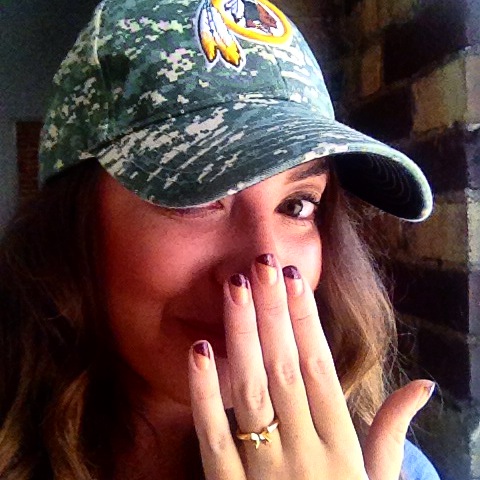
I suddenly felt very aware of passersby taking in the feathered Native American emblazoned on my camouflage hat while I walked to an East Village sports bar. In the past I would have perceived their judgments as no more than a definitive ruling on my team’s performance, but now I’m not so sure.
My Washington Redskins gear is exactly what you’d expect of a girl fan – many ranges of colors with different sleeve lengths, at least two hats and, of course, drinking cups. The day of the season opener I painted my finger nails burgundy and sparkling gold. Hail no I didn’t think it was too much – I’m a fan.
I know people who are racist. We all do. Until I moved out of my home country of Virginia (Redskins country) it never occurred to me that I might be one of them.
My coworker is adamant that it’s an act of racism if I continue to wear Washington Redskins apparel. I disagree because I separate the individual footballers who play the games Sunday after Sunday from the umbrella of their brand. To me, it’s much the same as supporting the military even if we’re opposed to the war. The individual soldiers did not decide to go to war; they’re simply carrying out orders. Are the Redskins players not just simply carrying out the job for which they were hired and paid handsomely for? Using this reasoning I don’t think it’s fair to expect me to turn my back on my team.
The Washington Redskins were formed in 1932 in Massachusetts under the name the “Boston Braves.” The next year they were rebranded the “Boston Redskins.” According to a letter written by Redskins owner Dan Snyder, the team had four players and a head coach who were Native American at the time.
“The name was never a label. It was, and continues to be, a badge of honor,” he wrote to fans in October 2013 when calls for the name change were rife.
He backed up this claim with polling responses. “The highly respected Annenberg Public Policy Center polled nearly 1,000 self-identified Native Americans from across the continental U.S. and found that 90% of Native Americans did not find the team name ‘Washington Redskins’ to be ‘offensive,’” he wrote to the legion of Redskins fans.
In April 2013, an Associated Press survey found that 79 percent of the respondents did not believe the team should change its name. Six months later, the Washington Post poll conducted its own poll to accompany Snyder’s statement. It showed that 62 percent of readers believed the team should change its name.
The name is racist and needs to be changed.
The name is racist because it is a derogatory reference to a group of people based on their skin color. The name is racist because it refers to a group of oppressed people who would not use that term to refer to themselves. The name is racist. But, the team is not.
One day I believe the Washington Redskins will become the Washington Warriors – a widely accepted and acceptable name for them. One day Dan Snyder will see the frivolity in his baseless claims that the name isn’t offensive. He will see that while changing the name will hurt in the short term, it is a wise, long-term investment decision (the revenue from the sale of new merchandise alone should be incentive enough.) One day hometown Washington Redskins fans will no longer be able to deny the fallacy they’ve been telling themselves. That lie being that the name isn’t offensive and the rest of the nation has just become too politically correct. One day the fans will accept a name change after realizing they would never stand behind a team called the Washington Whiteskins.
But, that day isn’t today. And it won’t be during this season and it most likely won’t be next season, either.
Therefore, I will continue to support my team, the Washington Redskins, with full knowledge that I am not a racist. I will call my team by their name until it changes. It is their name. It is what they call themselves. It is what the sports commentators call them and what the NFL lists them as on the league roster.
Whether it’s agreeable or not – it is their name. And in order to support the players and the team I love, I will wait to until that time comes to bench my Redskins apparel.
Are you a digital marketer? Best practice marketers align their objectives with business outcomes to improve the organization; they use data-driven decisions to predict outcomes and can envision the impact of their work. They think strategically to maximize revenue and create contextual engagement with the customers they serve. To do this, they use solutions that aggregate the right metrics and tools that help them derive accurate insights.
The definitive guide to the top 15 Digital Marketing Metrics for 2015
Here’s a peek at the first three to get you started:
1. Social interactions – Your firm’s social interaction ratio is determined by the total number of interactions all of your accounts received within the last week, month or quarter. You’ll first need to decide how frequently you’d like to measure your social media interactions, which is necessary to increase the number of interactions and build rapport with your customers and client base.
Next, you’ll want to determine your share of the social voice. Share of Voice is defined as the proportion of the total audience commanded by your brand across its full range of media activities.
Share of Voice is an accurate indicator as to where you rank compared to your competitors when people talk about your industry.
2. Amplification Rate – The amplification rate is the frequency at which your followers take your content and share it through their own network. It goes without saying that the higher the amplification rate, the further your content will reach.
This will also increase your social media page views, which is the number of times a web page is viewed as a result of being directed from a social media channel.
3. Quality Score – The quality score is a score assigned by search engines such as Google, Yahoo and Bing that influences both the rank and cost per click of ads. The purpose of the quality score is to enable the major search engines the ability to maintain and improve the quality of advertisements listed on their sites. The primary reason for this is to improve the experience of users who click on sponsored links. The more relevant the advertisements, the greater the likelihood a user will click on them more frequently, which increases revenue for everyone.
Those who achieve higher quality scores are rewarded with top placement and lower bid cost.
It’s no secret the oil and gas industry is struggling to obtain and retain a skilled labor force. Recent bad press coupled with the aftereffects of the recession of oil prices in the 1980s and 1990s has caused a major hiring gap in the sector. Furthermore, intra-industry poaching has placed a lot of power into the hands of the established workforce and corporations continue to fight over the small group of talented, younger employees who are entering the workforce.
How do you get a leg up in this human capital landscape? The first place to start is by looking to other industries that are successfully recruiting, training and retaining their workforce. Take a look at what you can do now in three easy steps:
Recruiting & Early Engagement
By now you should know Millennial candidates are cut from a different cloth than your seasoned professionals. You’ll need to roll out the red carpet for them in order to catch their attention. As much as it may hurt to do so, you’ll also need to court them. Here are some ways you can catch the eye of your prospective Millennial hire:
Interactive video game tour: Let them meet you virtually by creating a walk-through of your offices or sites to show them what’s in store after they’re hired.
Appear to be selective: You may be secretly dying to hire a fresh graduate, but don’t let them know that. Make them want to work for you, too, by letting them know you are being selective in your hiring process. That way once they’re hired it will be on an even playing field.
Go green: Environmental concerns are rife in the O&G industry and at top-of-mind for many Millennials no matter the industry. If you don’t already have a “Go Green” strategy, it’s time to start one.
Rating systems: This is scary, but it’s best to be transparent with your company culture. Millennials are information collectors and thrive off the reviews of others. Let your current and prospective employees rate their hiring, training and development programs. Trust me; you’ll be better for it. Read some more creative recruitment tips
Learning & Development
Since O&G companies are chasing higher risk assets in more complex geographical locations, employees are expected to develop practical skills to safely manage the expansion of their organization’s operations at a faster pace. This is a tall order.
The key to a successful L&D program is to impress competency and autonomy in employees from the get-go so they can begin operating and demonstrating ROI.
Often what an employees needs to boost morale and performance in a high pressure environment is a bit of technological or human support. This helps them learn and retain information more effectively. It’s important to recognize the long-term value of learning, long beyond the initial training sessions have ended.
When you make an effort to improve employees’ abilities, they will, too. Taking an interest in employee learning is a visible way of showing them that you are spending time and money to make them better. It sends the message that they can be even more valuable to you, and that you are willing to do your part to make them so, according to Jason Silberman, Managing Director at WalkMe.
There are three important ways to hopefully help give a disengaged employee the lift they need; by multi-directional strengthening communication, encouraging and reward success, and showing that you care about his or her long-term learning and performance.
Knowledge Transfer & Succession Planning
More than half of the oil & gas workforce is approaching retirement. The time is now to prepare for knowledge transfer and succession planning to ensure safe continuity of operations.
The key is to start the conversation between younger employees and senior leaders. Utilizing incentive programs for this engagement and allowing the more senior employees to work virtually or on more flexible part time schedules will entice them to stick around to pass on their skills and knowledge.
Some additional succession planning tips include:
Holding regular talent reviews. Review talent across departments and managerial levels. Talk about your employee’s strengths and weaknesses, but also take into account everyone’s knowledge of the particular employee before approaching them about their particular succession plan.
Identify only viable successors. Identify the employees with the most potential for a top position in your organization. Be forward thinking and consider roles for certain employees who are particularly talented – even if those roles aren’t currently in existence within the company.
Build a pipeline. If you advance an employee, make sure to fill the void where they left off. It’s as simple as that. Read more succession planning tips here.
It took one initiative: Making Red Hat University Managers more aware and passionate about using education as a retention tool for great talent to make a significant impact on their employees. Michael Paquin, Director of Red Hat University, says the number of unique sales department students to attend their university training classrooms, LMS and other sites increased from a few hundred to over 2,000 in one year alone. This, just from inserting some excitement in their managers. Further, the average quantity of training consumed per-person also jumped from low single-digits to mid-teens globally. Read on for more information on Michael’s achievements or see how you can hear him in person.
HH: What were your biggest ‘wins’ and ‘lessons learned’ from launching a global training and performance enablement program from the ground up?
MP: The most important lesson I’ve learned recently is that collaboration attracts commitment. The most successful programs we’ve launched recently are those that have honored the expertise of subject matter experts, enabled these experts to share their experience in training solutions they co-authored with us and engaged the students of these programs as valued contributors to future iterations of the program. Our corporate university is accountable for the existence of impactful training and performance enablement programs and I’ve learned success comes most easily when the business is actively responsible for their development and adoption.
A “win” I intend to carry on through the rest of my career is defining the role of the corporate university as a connector between training demand and sources of quality training. We are having great success as the creator of a bazaar-like community in which we may initiate and foster the growth of training programs but our community of associates are welcomed and encouraged to create their own as well. This is how we are turning training from being an event to becoming a natural part of our ongoing development and daily life at Red Hat.
I interview Mike Paquin, the Director of Red Hat University on corporate learning and development.
HH: Your team not only creates the content and curriculum, but it also executes on internal and external instruction. Would you walk us through the steps it took to modify the skill set and priorities of the team to result in a 20x increase in student count and a 50x increase in content development productivity?
MP: Our corporate university was established with the mission of creating high-quality learning content to orient, onboard and prepare Red Hat associates to succeed in key responsibilities of their jobs. We built an impressive library of excellent instructor-led and web-based offerings that was highly praised and well attended.
The problem was Red Hat associates were not coming back to the corporate university in quantity after their first 90 days on the job. For an HR organization attempting to build an integrated approach to managing enterprise talent this lack of ongoing talent development data posed a huge problem. Furthermore, we identified our content design and development methodology was too slow and intense for rapidly building new content and giving associates a reason to come back to the university.
We chose to invest in re-branding and advertising the corporate university but the most significant accomplishment contributing to growing associate participation with our corporate university was a year spent strengthening the talent management competency in our corporate managers. As an example, in one year focusing on our sales department managers we increased our unique student count from their department in university training classrooms, LMS, and other sites from a few hundred to over two thousand and increased the average quantity of training consumed per-person from low single-digits to mid-teens globally just by making managers more aware and passionate about using education as a retention tool for great talent.
As associate visits to the university increased, so did the demand for learning content. To meet demand, we needed to change our assumptions about what training content looked like, where it came from and how it was made available to associates. As a result we changed our instructional design methodology to emphasize reusability of learning objects across training programs, changed our tools to more mainstream products to make it easier to find highly skilled talent to recruit, and we aggressively pursued reusable content from other teams and enabled them to distribute their quality training materials through our corporate university brand. The result was a learning library that grew significantly faster than before and each member of our content development team roughly doubled the quantity of training hours they produced by minimizing redundancy and simplifying the technical structure of our learning content.
HH: What factors do you think are most important in maintaining the relevance of a corporate university in the current business climate?
MP: Above all else, the corporate university must establish a consultative relationship with their primary customers and stakeholders within the business. A corporate university is valuable as a training delivery organization but when the future impact of learning can be understood as business goals are being created then the university becomes an important and strategically relevant contributor to the business.
University leaders must also manage the change in learning expectations from Baby Boomers to Millennials in order to remain a trusted and relevant service for associates. I believe the key isn’t found in technology but rather in effectively collaborating on content. New “social learning” tools will come and go but core demands by Millennials such as transparency and the right to participate require their relationship with the corporate university to be bi-directional and welcoming to their unique contributions in order to maintain trust that the university is a relevant source to learn from. Our role as the university is to make associates successful and we can only remain a trusted and relevant partner when we respect what “learning” means to associates and keep the focus on their business and career success.
HH: How can a business know when it’s time to update its learning measurement program?
MP: Every business goes through cycles of growth, sustain, regroup, aggressive attack, etc. How learning should be measured entirely depends on what the business is trying to achieve at that point in time.
At every point when business strategy changes, when new business goals are set, or new organizational objectives are designed the learning measurement strategy should be questioned and reviewed. If the learning leader has any difficulty connecting current learning data and analytics with a measurable business outcome then it’s probably time to update the measurement program.
Without strong executive support there is no way we could have achieved even a fraction of our current state with leadership training. Financially these programs are very expensive and our executives were very generous to fund them, but the most important contribution from our executives was the acceptance and public support of the “enterprise talent” concept.
If given the preference managers would tend to hold on to their talent and over time accumulate more in order to keep pace with high-growth business demands. The concept that talent belongs to the enterprise and we as managers are responsible for aligning the right talent to the right opportunity, even if that opportunity lies elsewhere in the company, took a lot of selling. Once we had a common understanding of what it meant to grow Red Hat with an enterprise talent vision then the investments we made into the actual leadership programs became valuable.
Our leadership development strategy and programs are constantly evolving. Many of our programs have achieved a steady state in terms of structure and curricula but who is targeted, in what region, and in what quantity requires constant updating to remain aligned to business growth forecasts so we spend our corporate dollars wisely. We are also constantly educating and motivating managers to build succession plans for themselves and key team members which keeps the demand for leadership development high.
The awkward silence. Far from foe, the awkward silence is your best friend.
Let me ask you something: What is your first reaction when you’re on the phone with someone and the natural flow of the conversation ends? If you’re like most people, it is to immediately fill the space with your words. Say something. Anything.
As a newspaper reporter and journalist, one of the best pieces of advice I ever received was to let the other person fill the awkward silence space. In journalism, this is a nifty technique that prompts the source to tell you information they might not have previously shared. In life, it’s a great technique for teaching you patience in conversation.
Most of us start out as selfish conversationalists. Raise your hand if you’ve ever experienced the following daftness: The man who drones on and on about his life and travels. The woman who cuts you off to share her opinion, story or antecdote, which she believes is far more relevant than what you have to say. We all hate these people. I was once these people — and it failed me miserably. Not only did I send people running for the hills with my self absorption, I was also failing to learn anything about anyone else.
If you don’t find someone interesting then your problem is you’re doing all the talking.
“What really knocks me out is a book that, when you’re all done reading it, you wish the author that wrote it was a terrific friend of yours and you could call him up on the phone whenever you felt like it.” – J.D. Salinger, author of The Catcher in the Rye
Since I made the long and painful process from becoming a “talker” to a “listener,” I have never met a boring person. Hear me out. People love to talk about themselves. This is a simple fact. If you start asking them questions about their life, work, family or hobbies you will find that they always come up with something interesting to say. What this means is that you also have something interesting to say.
A top excuse among aspiring writers is that they “don’t have anything to say.” We all have a story to tell. Simply write what we know. I’ve learned to ignore the snickering when I say that I write about my life. Oh, you don’t think my life as a twenty-something, middle-class white girl living in NYC isn’t interesting enough? You’re wrong. Someone, somewhere will be able to relate to me. And that’s the point of writing, isn’t it?
I don’t care if you’re a reformed drug dealer who was detained in Peru for six years on smuggling charges or if you’re a housewife in Oklahoma who has never left the United States. You and your story have value.
“What really knocks me out is a book that, when you’re all done reading it, you wish the author that wrote it was a terrific friend of yours and you could call him up on the phone whenever you felt like it.” – J.D. Salinger, author of The Catcher in the Rye.
When you write, write for yourself and write like you’re talking to a friend. I think you’ll find that by using this foundation












 Hannah Hager